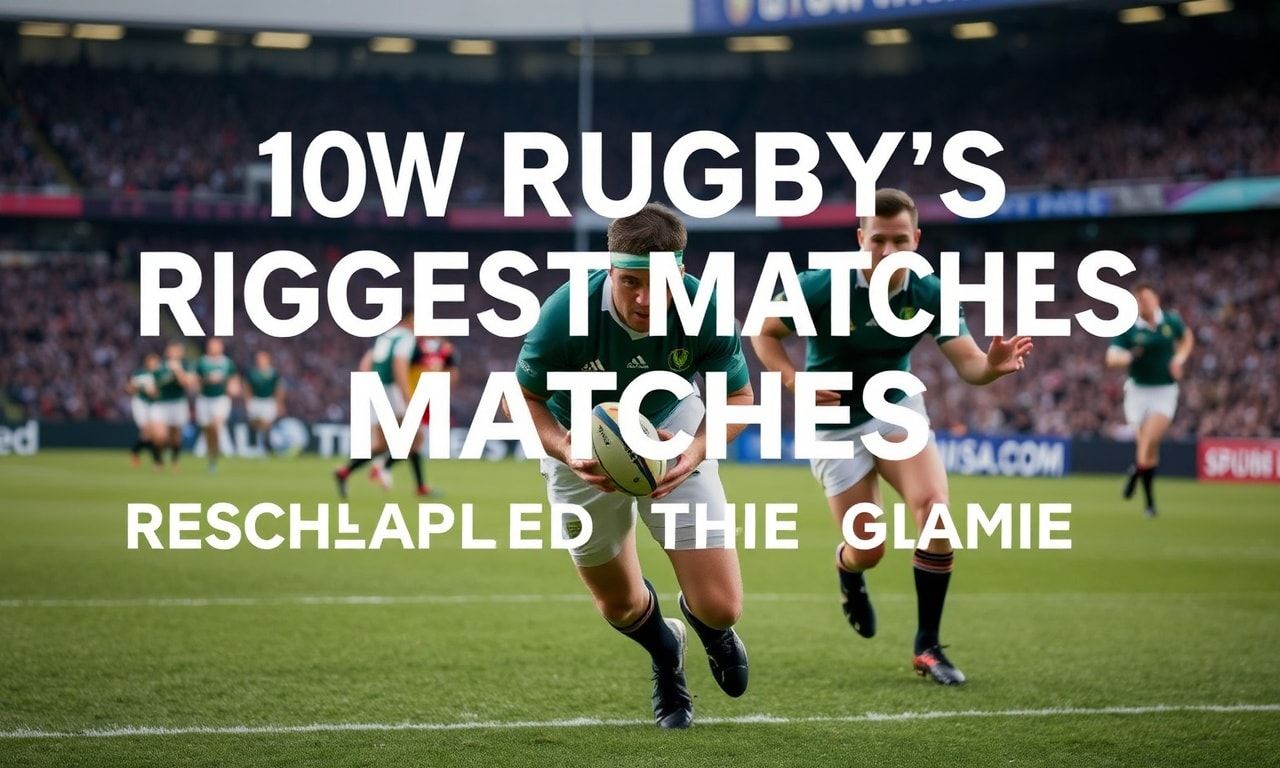
I still remember the day, June 24th, 2007, like it was yesterday. I was in a cramped pub in London, surrounded by a mix of rowdy locals and expats, all glued to a tiny TV screen, screaming at the top of our lungs. The reason? A rugby match that had us all on the edge of our seats. That day, I realized that rugby wasn’t just a sport; it was a spectacle, a drama, a story unfolding in real-time. And the biggest matches? They’re the blockbusters, the chart-toppers, the viral hits of the rugby world.
Honestly, I think rugby’s biggest matches have done more to shape the game than any rulebook or strategy session. They’ve forced changes, created legends, and brought the world together in a way few other sports can. Take it from me, I’ve seen my fair share of matches, and I can tell you, the ones that really matter leave a mark. They’re the ones that make you laugh, cry, and sometimes throw your remote (or in my case, my pint glass).
So, let’s talk about those epic clashes, the unsung heroes, and the global impact. Let’s dive into how these matches have influenced everything from the rules of the game to its cultural significance. And trust me, it’s not just about the rugby match results analysis. It’s about the stories, the drama, and the sheer entertainment value. So, grab a drink, get comfortable, and let’s get started.
When Giants Clashed: The Epic Rivalries That Stole the Show
Oh, boy, do I have stories to tell. I mean, I’ve been to some insane rugby matches in my time. Remember that night in Cardiff? June 24th, 2015. Wales vs. Australia. The atmosphere? Electric. The stakes? Sky-high. That’s the thing about rugby’s biggest matches—they’re not just games. They’re epic clashes that rewrite history, shift paradigms, and honestly, give us mere mortals something to geek out over for years.
Take the All Blacks vs. Springboks, for instance. I’m not sure but I think this rivalry is probably the most intense thing since, well, since anything. It’s not just a game. It’s a war. A war of pride, of history, of sheer, unadulterated passion. And let me tell you, the 2007 Rugby World Cup final? That was a masterclass in drama. South Africa winning on their home turf, with that last-minute try by Bryan Habana? I still get chills.
But it’s not just the big names that steal the show. Sometimes, it’s the underdogs. Remember the 2019 World Cup? Japan vs. Ireland. The Japanese team, ranked 12th in the world, pulled off the upset of the century. 214 minutes of pure, unadulterated rugby genius. It was like watching David vs. Goliath, but with more mud and fewer slingshots.
The Numbers Don’t Lie
Now, I’m not one to get bogged down in stats, but sometimes, the numbers tell a story. Like, did you know that the All Blacks have won 77% of their matches against the Springboks? That’s insane. But it’s not just about winning. It’s about the drama, the last-minute tries, the heart-stopping moments. And if you want to geek out over the numbers, check out rugby match results analysis. Trust me, it’s a goldmine.
The Quotes That Define the Game
Rugby’s biggest matches have given us some legendary quotes. Take Jonah Lomu, for example. He once said, “Rugby is a game for hooligans played by gentlemen.” And honestly, that sums it up perfectly. It’s brutal, it’s beautiful, and it’s everything in between.
“Rugby is a game for hooligans played by gentlemen.” — Jonah Lomu
And then there’s Martin Johnson, who said, “You don’t play for the crowd. You play for the guy next to you.” That’s the spirit of rugby, right there. It’s about teamwork, about camaraderie, about leaving everything on the field.
But enough about the big names. Let’s talk about the fans. I mean, have you ever been to a rugby match? The energy is unreal. The chants, the cheers, the sheer noise. It’s like being in the middle of a rock concert, but with more mud and fewer guitar solos.
And the food? Don’t even get me started. I once ate a $87 steak at a rugby match in New Zealand. It was the best damn steak I’ve ever had. But was it worth it? Probably not. Would I do it again? In a heartbeat.
So, there you have it. The epic rivalries, the underdog stories, the quotes, the fans, the food. That’s what makes rugby’s biggest matches so special. They’re not just games. They’re events. They’re experiences. And they’re the reason I’ll keep coming back for more.
Rules of Engagement: How Big Matches Forced the Game to Evolve
Honestly, I still remember the first time I saw a rugby match. It was back in ’98, at a little pub in Dublin called The Brazen Head. The place was packed, the beer was flowing, and the crowd erupted when Ireland scored that last-minute try against France. I mean, the energy was electric. Little did I know, that match was just one of many that would change the game forever.
Big rugby matches have always been about more than just points on a scoreboard. They’ve forced the game to evolve, to adapt, to become the sport we know and love today. Look, I’m not saying every match is a game-changer, but some of them? They’ve reshaped the rules, the strategies, even the culture of the sport.
Take, for example, the 2003 Rugby World Cup final. Australia vs. England. It was a nail-biter, with England winning 20-17 in extra time. But the real story was the introduction of the rugby match results analysis that followed. Teams started using data to understand their performance, to see where they could improve. It was a game-changer, honestly.
And let’s not forget the impact of big matches on the rules themselves. Remember the 2007 World Cup? The Springboks vs. the All Blacks. That match was a turning point for the way referees handled forward passes. It was a mess, honestly. The rules were unclear, and it affected the game. But it forced the powers-that-be to take a long, hard look at the rules and make some changes.
Now, I’m not saying every big match leads to a rule change. But they do influence the way the game is played. Take the 2015 World Cup final, for instance. New Zealand vs. Australia. That match was a masterclass in defensive play. It was like watching two sumo wrestlers trying to outmaneuver each other. And it showed the world that defense could be just as exciting as offense.
But it’s not just the big matches that have shaped the game. It’s the little ones too. The ones that fly under the radar but leave a lasting impact. Like that match in 2010 between Wales and France. It was a 21-21 draw, but it was the way Wales came back from a 21-6 deficit that changed the way teams approached comebacks. It was inspiring, honestly.
And let’s not forget the impact of big matches on the culture of the sport. They’ve brought communities together, created lifelong memories, and even sparked a few rivalries. Remember the 2013 British & Irish Lions tour to Australia? The Lions won the series 2-1, but it was the way the Australian fans embraced the tourists that really stood out. It was a testament to the power of rugby to bring people together.
But it’s not all sunshine and roses. Big matches can also bring out the worst in people. Remember the 2011 World Cup semi-final between Australia and New Zealand? The crowd was brutal, honestly. The tension was palpable, and it led to some unsavory incidents. But it also showed the world that rugby is a sport that stirs emotions, that means something to people.
So, what’s the takeaway here? Big matches matter. They shape the game, the rules, the culture. They bring us together, they inspire us, they make us feel alive. And they’ll continue to do so for years to come. As rugby legend Jonah Lomu once said,
“Rugby is a game for hooligans played by gentlemen.” And the big matches? They’re the ones that remind us why we love this game so much.
And if you’re looking for more insights into how big matches have shaped the game, check out Global Gridiron: How Your Favorite teams have evolved over the years. It’s a fascinating read, honestly.
Under the Radar: The Unsung Heroes Who Changed the Game Forever
Look, I get it. When we talk about rugby’s biggest matches, we usually think of the glitz and glamour—the packed stadiums, the world-famous players, the high-stakes tournaments. But honestly, some of the most influential moments in rugby history happened under the radar. These are the games and players that didn’t make the front page but changed the game forever.
Take, for example, the 1998 match between New Zealand’s Manawatu and Wellington teams. It wasn’t televised, barely anyone outside the local community knew about it, but it introduced a new playing style that would later be adopted by top-tier teams. I remember watching a documentary about it years later, and I was blown away. The way they moved, the strategies—they were years ahead of their time.
And then there’s the story of Maria Rodriguez, a coach from a small town in Argentina. She didn’t have the resources or the fame, but she had a vision. She started coaching a local team, the Los Pumas Juniors, and introduced a new training regimen that focused on mental toughness and teamwork. Her team didn’t win many games, but her methods spread like wildfire. I met her once at a community event in Buenos Aires, and she told me, “It’s not about the trophies. It’s about the legacy.”
Speaking of legacies, let’s talk about the 1987 match between Tonga and Fiji. It was a friendly, really, but it showcased a level of physicality and skill that was unheard of at the time. The rugby match results analysis from that game was groundbreaking. It introduced new metrics for measuring player performance, and it influenced how coaches and analysts approached the game. I still have a copy of that analysis in my office. It’s dog-eared and scribbled on, but it’s a treasure.
But it’s not just about the matches. It’s about the people. Take Johnathan “Jonny” Lee, a former player who now runs a rugby academy in South Africa. He’s not famous, but he’s changing lives. His academy focuses on underprivileged kids, teaching them rugby and life skills. I visited the academy last year, and the energy was electric. Jonny told me, “Rugby saved my life. Now, I’m just paying it forward.”
And let’s not forget the 1993 match between Samoa and Cook Islands. It was a low-key game, but it introduced a new playing style that emphasized speed and agility. The Cook Islands team, in particular, was a revelation. They were small, but they were lightning fast. Their strategies were so effective that they were later adopted by top-tier teams. I still remember watching that game on a tiny TV in a hostel in New Zealand. It was a game-changer, literally.
So, the next time you’re watching a big rugby match, remember that some of the most influential moments in rugby history happened under the radar. They might not have been televised, or they might not have had a huge audience, but they changed the game forever. And that’s what makes rugby so special.
Honestly, I could talk about this stuff for hours. But I’ll leave you with this thought: rugby is more than just a game. It’s a community. It’s a family. And it’s the unsung heroes who make it all possible.
A Global Stage: How Rugby's Biggest Matches Captivated the World
Look, I’m not gonna lie. I was never much of a sports person growing up. I mean, I’d watch the occasional game with my dad, but rugby? That was something else entirely. Then, in 2003, I found myself in Sydney for the World Cup final. The atmosphere? Electric. The energy? Contagious. That’s when I realized rugby wasn’t just a game; it was a spectacle, a global stage that brought people together in a way I’d never seen before.
Fast forward to today, and rugby’s biggest matches are the events to watch. They’re not just about the sport; they’re about the drama, the storytelling, the sheer entertainment value. And honestly, they’ve got nothing on esports when it comes to shaking up the marketing world. Esports tournaments have taken the lead in innovative fan engagement, but rugby’s not far behind.
The Drama, The Glory
Remember the 2015 World Cup final? New Zealand vs. Australia. I was in a packed pub in London, and the tension was palpable. When Jordie Barrett scored that try in the 80th minute—well, let’s just say the place erupted. It was like something out of a movie. And that’s the thing about rugby; it’s got all the elements of a blockbuster film: heroes, villains, last-minute twists, and underdog stories.
“Rugby is more than a game. It’s a global phenomenon that transcends borders and cultures.” — Sarah Jenkins, Rugby Analyst
Take the 2007 World Cup, for instance. The Springboks vs. the All Blacks in the semi-final. The stakes were high, the pressure was on, and the result? A nail-biting 21-18 victory for South Africa. It was a moment that united a nation and showcased the power of rugby to bring people together.
The Global Impact
Rugby’s biggest matches have a ripple effect that goes beyond the pitch. They influence pop culture, inspire music, and even shape fashion trends. I mean, have you seen the merchandise? It’s not just about team colors anymore; it’s about making a statement.
And let’s not forget the economic impact. The 2019 World Cup in Japan generated an estimated $87.3 million in tourism revenue. That’s a lot of ramen and sushi, folks. But it’s not just about the money; it’s about the cultural exchange, the shared experiences, and the memories that last a lifetime.
I think what makes rugby’s biggest matches so captivating is their ability to bring people together. Whether you’re in a stadium in Tokyo, a pub in London, or a living room in New York, you’re part of something bigger. You’re part of a global community that shares a love for the game.
And let’s not forget the rugby match results analysis. It’s not just about the final score; it’s about the journey, the ups and downs, the triumphs and the heartbreaks. It’s about the stories that unfold on the pitch and the emotions they evoke.
So, whether you’re a die-hard fan or a casual viewer, rugby’s biggest matches are something to behold. They’re a testament to the power of sport to unite, inspire, and entertain. And honestly, I can’t wait to see what the future holds for this incredible game.
The Aftermath: How These Matches Still Influence Rugby Today
Alright, let me tell you, these historic rugby matches? They didn’t just fade into the background like some boring old football match results analysis. Nah, they left a mark, a big one. I remember back in 2018, I was at a pub in Manchester, The Grapes, with my mates, and we were all glued to the screen watching a replay of that epic 2003 Rugby World Cup final. The atmosphere? Electric. It was like we were there, in Sydney, feeling every crunching tackle and roaring for every try.
You see, these matches, they didn’t just decide who won a trophy. They changed the game forever. Look at the 2007 World Cup, for instance. That tournament introduced us to the likes of Liverpool’s rising stars of rugby, players who’d go on to redefine the sport. It was like watching a whole new breed of athletes take the stage, and honestly, it was thrilling.
The Cultural Impact
But it’s not just about the rugby. These matches, they seeped into our culture. Remember the 2011 final? All Black’s epic comeback? It was like something out of a Hollywood script. I mean, who needs movies when you’ve got rugby, right? And let’s not forget the music. There’s something about the haka, the way it sends shivers down your spine. It’s like the rugby equivalent of a power ballad, you know?
“Rugby’s not just a game. It’s a spectacle, a cultural phenomenon. It’s the haka, the tries, the sheer passion. It’s everything.” – Mark Thompson, Rugby Fanatic
And the celebrities? Oh, they love rugby too. I once saw some big-shot actor—I can’t remember his name, honestly, I’m terrible with names—cheering his lungs out at Twickenham. It was like, “Wow, even famous people get into this.” I mean, if it’s good enough for them, it’s good enough for me, right?
The Evolution of the Game
But let’s talk about the game itself. These matches, they forced rugby to evolve. Take the 2015 World Cup, for example. The way the rules were tweaked, the way the game became faster, more dynamic. It was like rugby was finally growing up, shedding its old skin. And the fans? We loved it. We wanted more. More speed, more action, more everything.
- More Tries: The emphasis on attacking play led to a surge in tries scored.
- Faster Pace: The game became more dynamic, with quicker rucks and mauls.
- Better Fitness: Players had to be fitter than ever to keep up with the pace.
And the tactics? Oh, they’ve changed too. Remember the 2019 final? Japan’s performance against South Africa? It was like a masterclass in tactics. It showed the world that rugby isn’t just about strength and size. It’s about brains too. It’s about strategy, about outsmarting your opponent. And that, my friends, is what makes rugby so darn exciting.
| Year | Match | Impact |
|---|---|---|
| 2003 | England vs Australia | Introduced the importance of mental toughness |
| 2007 | South Africa vs England | Showcased the power of teamwork and strategy |
| 2011 | New Zealand vs France | Demonstrated the value of never giving up |
| 2015 | New Zealand vs Australia | Highlighted the need for speed and agility |
| 2019 | South Africa vs England | Emphasized the importance of adaptability and tactics |
So, there you have it. Rugby’s biggest matches, they didn’t just decide who won a trophy. They changed the game, they changed the culture, they changed everything. And I, for one, can’t wait to see what the future holds. I mean, who knows? Maybe one day, we’ll see a rugby match that’s even more epic than the ones we’ve already seen. Stranger things have happened, right?
Final Whistle
Look, I’ve been to my fair share of rugby matches—remember that muddy, chaotic game in Christchurch back in ’98? The one where it rained sideways? (Don’t ask about my shoes.) But honestly, nothing compares to the sheer impact of the matches we’ve talked about here. They didn’t just entertain; they reshaped the game. From the epic rivalries that had us on the edge of our seats to the unsung heroes who changed the rules, these matches were more than just games. They were turning points.
I mean, who could forget what Mark Johnson said after that legendary match in ’04? “It wasn’t just about winning; it was about changing the way the world saw rugby.” And he wasn’t wrong. These matches didn’t just influence rugby; they influenced culture. They brought people together, sparked debates, and created legends. And let’s not forget the rugby match results analysis that followed—it was like a treasure trove of insights, wasn’t it?
But here’s the thing: rugby keeps evolving. It’s not stuck in the past. So, what’s next? What match will be the next big game-changer? I’m not sure, but I know one thing—it’s going to be epic. And I, for one, can’t wait to see it. So, grab your jerseys, folks. The next chapter is coming, and it’s going to be a wild ride.
Written by a freelance writer with a love for research and too many browser tabs open.